Wednesday, 30 January 2013

My favourite neighbourhood: Vračar


In the past year and a half, since I changed my life in Rio for a new life here, in Belgrade, I lived in several different apartments - four of them, to be precise. Despite all the bother of moving my stuff around from here to there, it was an interesting in a way cause I got to know several different parts of the city. I've lived in the very city centre (Stari Grad, meaning "Old Town") for 7 months; then, I temporarily shared my friend's flat in Kotež for several months, while I looked for the perfect flat in a more central part of the city; after a long search, I moved to the district of Vračar, to a flat that was far from perfect, but that was nice nevertheless. I lived in there for 5 months until when, all of a sudden, I was kinda "forced" to move out. After only a week looking for a new place for myself, I found the apartment I'm currently living in - and hope to live for quite some time now. Enough flat hunting and moving for me! But the best of it all concerning this new flat is that I only had to move 3 blocks away from my previous flat, meaning that I'm still in the heart of Vračar! To make it all even better, I have an amazing view from my balcony - and I'm a sucker for a room (or a balcony) with a view!

The view from one side of my balcony <3

I always fancied Vračar, really, since I came to Belgrade the first time in 2007. But since I moved here last August, this neighbourhood grew on me even more and became one of my favourite parts of the city.
It is very close to the city centre (in fact, borders the "Stari Grad" district) and through Slavija Square (a public transportation hub) it's very well connected will all of the city.
One of the reasons for my love for Vračar is that it reminds me a lot of my former neighbourhood in Rio de Janeiro, called Laranjeiras: small (it's area covers less than 3 sq. km!) and residential, uphill, full of small streets surrounded by trees, historical, a neighbourhood who flourished after mid 19th century, when it was considered fancy and hosted many European style houses and buildings.
Walking through Vračar today one can barely tell it's such an old, historical part of the city. Most of its buildings nowadays date from after 1945 since during the WW2, due to bombing on different occasions, most of its old original buildings were completely destroyed.

The coat of arms of Vračar

But let's get back in time further more, back to the origins of this Belgrade neighbourhood.

The name and Vračar first appears 1492, in Turkish-Ottoman documents and plans for the conquest of Belgrade, lead Suleiman Pasha. Later on, in 1560, Vračar is again mentioned in official Ottoman documents, described as a small Christian settlement within the then Turkish Belgrade, comprised of (only!) 17 houses, on the outskirts of the town.

The origins of the name of Vračar itself, its etymology, is full of controversy. The oldest story dates back from the early days of Ottoman occupation in Serbia, more precisely from 1495, and it says the name Vračar to be derived from the Serbian word vrač (meaning a healer, a doctor/sorcerer, a medicine man) who lived around in this part of town. Other source, dating from 1521 - the very year when Belgrade fell into Ottoman siege - suggests that Vračar was the name of a Christian man who lived in one of the very few huts/houses that existed in this area back then. I wonder if the man mentioned on the first half of the 16th century could be the physician mentioned in 1495? Hmm...
There's also a 3rd theory: my ex-boyfriend told me once that the name Vračar comes from the name of a bird, vrabac (sparrow, in English), since many of those used to inhabit this region, giving it the name of Vračarsko Polje, later on referred to as simply "Vračar".
Despite which of these possibilities is the historically accurate one (if any of these, at all), this part of the city has much more history to itself than this. ‎

In 1595, as a result of a Serbian uprising again the Ottoman occupation, the remains of the Serbian Orthodox patron saint Sv. Sava were brought from the Mileševa Monastery (where they were resting since 1237) and, under orders of the Albanian Grand Vizier Sinan Pasha, were burned on the Vračar hill. On the first half of the 20th century, the temple of Sv. Sava was set up on the location believed to be where the saint's remains were set fire nearly 500 years ago. (more about the temple below)

Ottoman troops burning the remains of Sv. Sava in Vračar

In the 19th century the term Vračar started being used to refer to a broader, wider geographical area of the city, nearly three times bigger than the area of the present day district itself.
In 1806, when the first Serbian uprising (against the Ottoman domination) started, Serbian troops set one of their camps on the Vračar plateau. After Belgrade was first liberated from Turkish domination, the deceived Serbian soldiers were buried on this camp site and the place became known as the Insurgents Cemetery. In 1848, a Monument to the Liberators of Belgrade was erected by Prince Aleksandar Karađorđević on this very location and reconstructed a few years later, in 1889, when trees were also added around it, starting what is today Karađorđev Park - the oldest park in Belgrade.

Karađorđev Park and the Monument to the Liberators of Belgrade

It was also on the 19th century that the district saw a major growth and development: despite the city of Belgrade being under Turkish occupation, prince Miloš Obrenović ordered the construction of a new city centre on Western European standards, whereas most of the rest of the city beard all characteristics of an Ottoman town. This brought the implementation of broad streets and boulevards, new buildings to house administrative and public institutions of the city, parks and so on. The first results of this "westernisation" of Vračar was described by a journalist from The Times who published, in 1843, a text full of compliments to the new look of the district of Vračar:
"Four years have passed since the time when I was last here, and how Belgrade has changed! I have hardly recognised it. The high belfry on the church (Cathedral) now screens by its shadow the Turkish mosques; many shops are now provided with new doors and glass windows, oriental clothing is more rare and houses with several storeys, in European manner, are being built everywhere."
In the 1860's many architects and "builders"coming from Austro-Hungary and Italy came to Belgrade to join local prestigious architects on the efforts to make Vračar look more Serbian and less Turkish. After 1868, when the Turkish occupation was finally over and the Principality of Serbia gained its full independence, these architectural activities were extended from Vračar to downtown Belgrade, bringing down the ruins, old Turkish houses and Serbian huts and constructing new houses and buildings, turning Belgrade into a Austro-Hungarian looking capital.

Ottoman Belgrade ("The ruined gateway of Prince Eugene")

Turkish part of Belgrade shortly before its demolition, 1866

After the end of the 1st World War and the Balkans wars, the construction of Sv. Sava's Temple on the Vračar plateau attracted many rich citizens and notorious people to move to its surroundings, turning this part of Vračar into an elite part of city. Today, the temple of Sv. Sava (sometimes referred to as "cathedral") is definitely Belgrade's most famous landmark and Serbia's as well. The temple is also one of the 10 largest church buildings in the world as well as the Orthodox cathedral with the biggest internal space on the planet. It's massive!

The Vračar plateau, with the Sv. Sava Temple on the right and the roof of the National Library on the left.

Later on the 20th century, during WW2, Belgrade was heavily bombed by German-Nazi forces. The Nazi invasion started on April 6th 1941 and the bombing lasted for nearly four days. William Stephenson, a representative of British Intelligence during the 2nd World War, wrote about the bombing of Belgrade in his biography:
"After four days of what the Germans code-named Operation Punishment, some 24,000 corpses were recovered from the ruins. Untold numbers were never found."[11] The most important cultural institution that was destroyed was the National Library of Serbia, with 300,000 unique items including priceless Medieval manuscripts."
On Easter 1944, Belgrade was again heavily bombed, but this time around by allied forces, killing nearly fifteen hundred civilians against less than 20 German military losses. The Čubura area of Vračar was almost completely destroyed by the bombing and today a monument in this area pay tribute to the civilians deceived on that occasion.

A street in Čubura before the WW2 bombings

Kičevska street after the 1944 allied forces' bombing (source)

On the years that followed the end of the war, a huge reconstruction effort took place in Belgrade, and most of the buildings standing in the city today date from this period.

On 1966, the new building of the National Library of Serbia started being built just beside the temple of Sv. Sava. A new, modern building carefully planned to host all remaining and restored books and documents that survived the bombing of the former National Library during WW2.
I love it there, by the way! The annual membership costs 2.000,00 Dinars (less than 20 Euro!) and it's a great place for studying, reading and researching. I highly recommend it!

Flowers on the site of the former National Library on the anniversary of its bombing by Nazi forces, over 70 years ago

The National Library of Serbia
The renovated interior of the National Library

Today, Vračar is under huge real state growth, with tones of new, modern apartments' buildings being built over the past few years, bringing down most of the very few remaining houses from the first half of the 20th century.

Vračar today: plenty of new buildings and very few remaining old houses

Still, Vračar is a very pleasant district to live in: it's full of small, shady streets, many major shops and stores (most of them on Bulevar Kralja Aleksandra) as well as small shops of all sorts (some of which became my favourite, I'll write about some of them later!), a full range of services, museums, theatres, the biggest green market in the city (called Kalenić), some really nice restaurants, kafanas and many - I said, many! - cafes!

On my next post, a list of my favourite spots in Vračar!


Wanna see more of Vračar? Check out the picture galeries here and here!

Saturday, 3 September 2011

A room with a view


About a month and a half before I came to Belgrade (around May), I started searching for a place to for me to live in once I arrived here. After a week searching through the web - and not being very successful, to be honest - I decided to call for a little help from my friends: I sent several emails and messages to most everyone I knew here in Belgrade, asking for some assistance with my search. Among the many replies I got (everybody was SO kind and helpful!) Ana - a Brazilian girl living here in Belgrade - suggested I should contact this real state company called Symbol Properties, since several people she knew were very successful in finding flats with their assistance.

I got in touch with Symbol Properties over email and they were extremely helpful and very professional, sending me a handful of interesting flat offers along a couple of weeks, all of them fitting my search criteria perfectly, as well as my limited budget. As the time of my arrival to Serbia approached, I decided for the 3 offers that I liked most: those would be the flats I was gonna visit as soon as I got Belgrade, in order to decide which one of them I'd take. All 3 apartments seemed to be great as for the pictures sent to me, but one of them really caught my eye. Don't know really why, but I kinda felt that that one was gonna be the_one I'd fall in love with once I visited it - and I was totally right! As soon as I stepped into it with the real state agent, I knew that was it! I didn't even had to sleep on it, I decided right away I'd take that one and, less than 24 hours later I was signing the contract and moving in.

Location-wise, it's perfect: in the very centre of the city, at this quiet square that rather reminds me of my neighborhood in Rio, "Praça São Salvador"... At night, specially at Fridays and Saturdays, the square gets packed with youngsters, drinking beer, talking loud and even playing some music. There are 24 hours markets and bakeries within 100 m from my building, not to mention my favourite baklavdžinica ever, "Dukat" and even a newly opened Israeli fast food place with really great falafel sandwiches! The main square and pedestrian zone of the city are within a 2 minutes walk from my place as well. And if I feel like clubbing, a slow 20 minutes walk will take me to some of the coolest "splavs" in the city.

But all those qualities will never measure up with the most precious quality of all of this apartment: I got a room with a view. And what a view <3


Thursday, 16 June 2011

Coming back in 5, 4, 3, 2...

Hey everybody!

I`ve been away for quite some time, I know... Awfully busy with last minute details of my return to Serbia, taking place on July 4th!!!
This time around I`ll be in Serbia for 7 months in a row (!!!), studying Serbian language and getting to know a bit better the country and its neighbors. I`m SO looking forward to this long trip, counting the seconds to be there again from summer to winter.

All in all I just meant to say that in a couple of weeks time I`ll be back here, posting as much as I possibly can and updating you all with my lateste experiences and adventures in the Balkans :)

Stay tuned, more info about my travel plans and route in the forthcoming days!

Sunday, 24 April 2011

What a Kafana is?

I was just about to post my 3rd entry for the "Minha Belgrado" series, pointing out some of my favourite "kafanas" in Belgrade. But then I realised that most people who had never been to Serbia before probably have no idea what so ever of what a kafana is. So I thought it would be cool to write a bit about it.

Some would simply describe kafana as the serbian equivalent of a tavern. But others - and I include myself into this group - would tell you that kafana is much more than just a tavern: it's almost a way of life!

The word "kafana" comes from the turkish word kahvehane, meaning something like "coffee place" or "coffee house". The first kafana in Belgrade was opened in 1522 in the neighbourhood of Dorćol, run by Turks - those were the early days of centuries of Ottoman occupation in the Balkans.
Although the "kafana concept" arrived in Belgrade in the 16th century, it was only in the 1700's - by the time of the second Ottoman occupation - that the term "kafana" started being used to refer to those coffee inns.


Alcohol only started being served in "kafanas" on the first decades of the 19th century. By that time, "kafanas" were increasing more and more in popularity, taking an important and special place in the development of social, economic and cultural life of Belgrade. It was the place where the known and the unknown people sat for a drink, as well as famous and anonymous writers, poets, journalists, actors and various artists, politicians and so on. It was a shelter for bohemians, travellers, students, people with no place to stay, prostitutes… Each kafana had their own physiognomy, character and guest circle.

Despite de taxes that Prince Miloš started imposing on kafana owners in the early 1800's (and the working licenses that were now required to run such places), by the end of the 19th century Belgrade was crowded with them: according to some statistics, by the turn of the 20th century Belgrade had 1 kafana/coffee inn for every 50 inhabitants!
By then, the number of "kafanas" in Belgrade was in fact so big that the owners of those places started looking for a different "something" to attract more customers - that was when live folk music acts were introduced in "kafanas".


Prior and between the two world wars, "kafanas" were the place where important events took place or decisions were brought and even members of political parties had their own, favourite kafana where they would go to on a regular basis.

Nowadays, "kafanas" continue to be a place for meeting friends, drinking, talking & discussing, live music, singing your favourite tunes out loud after tones of kilo kilo and so on. It's the place where a foreigner can best understand and experience Serbs and their social personalities.

Kafana "?" ("Znak Pitanja", or "Question Mark", in English), one of the oldest in Belgrade

On my next post, info and directions to my favourite "kafanas" in Belgrade ;)

Monday, 14 March 2011

At last, 2011 has started!

Here in Rio (and all around Brazil, I guess), people say that the year only really starts once carnival is over - and even though I hate to admit it's true, my posting absence here in my blog won't let me lie!

Anyways, I'm 100% back now, with tones of new projects and things to tell.
And just so you know, I've been away from blogging about Serbia and the Balkans for a couple of months, yes, but during this time I worked hard to keep the Balkans as close as possible to me.
Ladies and gents, I present you the Balkan Carnival Evening promoted by me and my work-partner, Sol Provvidente, with a band also produced by the two of us: the Go East Orkestar":


Enjoy, and till soon! ;)

Monday, 3 January 2011

Belgrade live street cams!

For those of you either curious or nostalgic about Belgrade, here are 4 live street cams placed on different locations of the "White City" - and 3 of them you can even control up and down, left and right and zoom in and out. Check out!

http://camera.beograd.com/
This camera is placed on Terazije, facing towards hotel Moskva. this one is "fixed", you can't control it. I believe that in a clear day you can even spot Hram Svetog Save at the far background :)

Now, the controlable cams!

http://www.informatika.com/webkamera/trg-nikole-pasica.htm
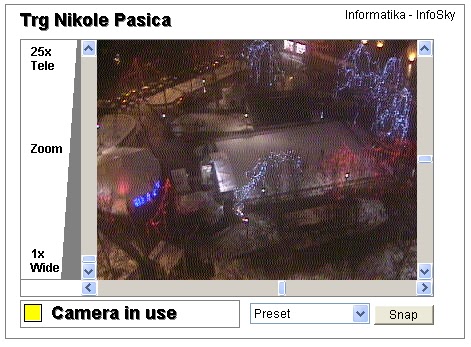
Trg Nikole Pašića: if you move this cam to the right you'll see the ice skating rink, which is always illuminated by colorful lights at night :)


http://www.informatika.com/webkamera/novi-beograd.htm
Novi Beograd: this cam shows a beautiful view of the new part of the city, specially at night, when the buildings are all lit up

http://www.informatika.com/webkamera/ada-ciganlija.htm
Ada Ciganlija: this cam is cooler during daytime and specially during summer, when the river island and its beaches are crowded with people.


Enjoy! :)

Sunday, 2 January 2011

Happy new year!

Just passing by quickly to wish you all a happy New Year!
May 2011 be a year with more arrivals, less departures and no farewells :)


Saturday, 18 December 2010

Expedição Go East 2011 - Go East Expedition 2011

For the english version of this, scroll down a bit

-----------------------


Desde que comecei a viajar pelos Balcãs e a escrever esse blog, muita gente - de amigos à pessoas que nunca vi na vida! - vem me perguntar sobre viajar para os lugares dos quais falo aqui. Perguntam sobre quais cidades visitar, pedem dicas sobre acomodação, sugestões sobre qual a melhor época para ir, o que tem pra ver e fazer por lá, e etc, etc.
Eu adoro receber e responder à esses emails! Pensar que eu posso estar contribuíndo (mesmo que um pouquinho de nada) na melhoria da imagem que as pessoas fazem dos países dessa região é priceless pra mim :)

Foi então que, no início desse ano, me ocorreu a idéia: já que tanta gente se mostra interessada em conhecer os Balcãs, porque não utilizar que aprendi nas minhas viagens e organizar, eu mesma, uma excursão pra lá?
E foi assim que "nasceu" o projeto Expedição Go East 2011.

A idéia principal da Expedição Go East é oferecer um roteiro de viagem budget e alternativo, diferente do roteiro que uma agência de turismo comum ofereceria. O foco da expedição é a música e cultura da região, o contraste do tradicional com o contemporâneo, o mix de culturas que faz dos Bálcãs uma região tão incrível e única.

Quando comecei a pensar num roteiro pra expedição, idéias e opções mil começaram a pipocar na minha cabeça. Eram tantas, mas tantas, que meses de viagem pela região não dariam conta!
Pra realmente começar a montar o roteiro, o primeiro passo foi decidir qual a melhor época pra fazer a expedição: verão! Mais precisamente em agosto, quando rolam diversos festivais na Sérvia, como Guča e a Beer Fest de Belgrado.
O passo seguinte foi perguntar aos que já haviam manifestado interesse no projeto sobre quanto tempo eles teriam disponível para uma viagem dessas: a média das respostas foi 15 dias.
Então pensei que em um roteiro de 15 dias seria melhor focar uma quantidade menor de países (podendo, assim, explorá-los melhor) do que passar correndo por vários e não curtir de verdade nenhum deles.
Assim sendo, resolvi focar o roteiro nos países que mais conheço e nos quais possuo mais contatos e possibilidades: Sérvia e Montenegro.


Considerando todos esses pontos, a Expedição Go East 2011 ficou então agendada pra durar do dia 4 ao 19 de agosto, cobrindo Sérvia e Montenegro e diversos festivais e eventos de música que rolam nesses dias.

Interessado? Se quiser saber mais sobre a Expedição Go East 2011 é só mandar um email para expedicaogoeast2011 @ gmail.com e eu lhe enviarei detalhes, roteiro e orçamento da viagem :)


-----------------------


Since I first started travelling through the Balkans and to write this blog, many people – from friends to people I never saw in my life! – started asking me about travelling to the places I write about on here. They ask me about which cities they should visit, tips on accommodation, what’s the best time of the year to travel, what is there to do over there and so on.
I just love to answer those questions! To think that I might be helping (even if just a tiny little bit) to improve those countries’ images on people’s minds is something priceless to me :)

That was when, earlier this year, than an idea occurred to me: since so many people show interest in travelling to the Balkans, why not using the things I learned in my travels and organise, myself, and excursion to those places?
And that was how my project Go East Expedition 2011 was “born”!

The idea behind Go East Expedition is to offer a budget and alternative travel route, different from what one would get with a regular travel agency. The main focus of this expedition is the region’s music and culture, the contrast between contemporary and traditional, the cultural mix that makes out of the Balkans such an amazing and unique region.

When I started thinking on a route for this expedition, thousands of ideas and options started popping out. In fact, the ideas were SO many that month after month of travelling wouldn’t be enough to cover them all!
To start really building the route, the first step was deciding which would be the best time of the year for this expedition: summer, more precisely in August, when many music festivals take place in that region.
The next step was asking those who had already shown interest in this project how many days they could take to do so such a trip: 15 days was the average answer I got.
Then, I thought that in a 15 days route the best thing would be focusing in less countries (allowing more time to explore them) rather than rush through many different countries and not actually enjoying any of them.
Therefore, I decided to build the route around the countries I know better and in which I have more contacts and possibilities: Serbia and Montenegro.


Considering all this, Go East Expedition 2011 is scheduled to last from August 4th to 19th, covering Serbia and Montenegro as well as many music festivals and events that take place by then.

Interested? If you want to know more about Go East Expedition 2011, send an email to expedicaogoeast2011 @ gmail.com and I will send you the excursion’s route, details and budget :)

Thursday, 16 December 2010

My 2011 diary

I finished the collage for the cover of my 2011 diary. Most of the images used on it were taken from magazines, weekly guides and folders I brought from my last visit to Serbia (last July/August).
It's the way a found to always have a bit of Belgrade with me, inside my purse :)

(click to enlarge)

Tuesday, 7 December 2010

"Minha Belgrado" #2 - Baklavdžinica "Dukat"

I'm not much into sugary, you know... But I will never forget the day I first tried baklava: it was in Varna (Bulgaria) on a Christmas Eve with my brother Kosta and his family and honestly, that was one of the best sweets I ever had in my life!!
Once I was back to Rio de Janeiro I started searching for places that sold baklava. I did manage to find several places but sadly enough, none of them had a baklava half as delicious as those I had in Bulgaria.

For those of you who that doesn't know exactly baklava is: well, it's a delicious sweet of Turkish origin, made out of tens of layers of fine, sweet phyllo dough, with different kinds nuts in between its layers, sweetened by honey. It's "heavenly", like my friend Valja says :)

But anyways, back to my "perfect baklava" search, I finally discovered (thanks to my friend Saša!) the best place ever for baklava and other Turkish sweets in Belgrade: Baklavdžinica Dukat!
"Dukat" is a pretty new place in Belgrade (reason why I had never heard of it in my previous visits to the city): it was opened on May 20th this year, at Topličin Venac, number 3 (next to "Tanjug" building)


The mastermind behind "Dukat" is Mustafa Avdžija (originally from Gaziantep, Southeastern Turkey), whom came with his family to Novi Pazar (Southwestern Serbia) in 2004. A few years later, he and his friend Nedžad Ličina (from Sjenica, Southwestern Serbia) decided to start a partnership, opening their Baklavdžinica "Dukat" in Belgrade.
With over 15 different kinds of baklava and other Turkish candies/sweets, "Dukat" quickly became a "summer hit" in Belgrade, as described by newspaper 24 Sata:

- Our speciality is pistachio baklava. There are also pistachio "sarmice" , "kraljevska kriška", chocolate baklava, "saray sarma" and so on. People get surprised when they see such variety. Here [in Belgrade] they're used to eat baklava only with nuts, but most people don't know that the true baklava is made with pistachio. People often ask for the recipe. I just tell them that everyone has its special craft and that these candies and its recipes cannot be made by anyone, only by masters - Mustafa explains. (Taken from here)

I didn't try all the kinds of baklava and candies they offer at Dukat, but I did try the pistachio baklava and pistachio sarmice and really, I can't describe to you how delicious it was! Maybe you can figure by looking at these pictures of the shop's glass window:


Pistachio "sarmica" 

Pistachio baklava
(Pictures taken from here)

I couldn't find here the exact working hours of "Dukat" but as I remember it was opened until early evening, around 7pm maybe. Prices of those sweet delights vary from RSD 1400 to RSD 1800 per kg (from around €13 to €17).
A Belgrade "must", for sure!

Wednesday, 1 December 2010

"Minha Belgrado" #1 - Accommodation in Belgrade

When planning a trip to no matter where, accommodation is usually the first thing that comes to people's minds. And when it comes to accomodation, Belgrade has plenty of options to offer!
The choice of what kind of accommodation suits you best depends on many facotrs, as:

- For how long will you stay in Belgrade?
- What is your budget?
- With how many people are you travelling with?
- What level of comfort and privacy are you expecting?


Option 1: HOSTEL

If you're planning a short stay in the city (up to 15 days) and you're on a tight budget, a hostel would be the best option. Privacy and comfort are not so great, but one of the best things about staying in a hostel is the amazing amount of people from all over the world you get to know. Also, people who work as part of the staff of those hostels are usually very helpful and very, very friendly!

Belgrade is full of hostels (check it our here and here). Here's a small list of some hostels I picked up, highly recommend:

Chillton Hostel
I never stayed on Chillton Hostel, but 3 friends of mine did in January 2009, and they just loved it! Chillton is located in the neighborhood of Vračar, just beside the mighty temple of Saint Sava (the biggest orthodox temple in the world!) and some 15 minutes walking from downtown (some 5 minutes by bus). Nice and quiet location.

Chillton Hostel #1

Hostel Captain Belgrade
I never stayed in this hostel, but as Dušan is the guy on charge of it, I'm pretty sure it must be very good. Dušan helped me finding an apartment to rent when I was in Belgrade in 2008, so I trust him when it comes to accomodation :)
Hostel Captain Belgrade has a great location (in Dorćol, one of my favourite parts of the city!), pretty near Republic Square (Trg Republike), the main pedestrian zone (called Knez Mihailova) and only a couple of blocks from Kalemegdan Fortress, my all-time favourite spot in Belgrade.

Hostel Captain Belgrade

In Old Shoes
This is where my best friend, Sanja, works now. When in Belgrade, I visit her at her working place day in day out, and the general feeling at "In Old Shoes" hostel is that of staying in someone's house - very cozy! Also, the hostel was voted #7 on the list of Top 10 Hostels in Belgrade! The location is awesome too, just some 7 minutes walking from the main pedestrian zone (Knez Mihailova).
Sanja told me a few days ago that the hostel is currently going on maintenance. But still, is worthy checking out with them when the renovation will be due! :)

In Old Shoes Hostel

Af-Terr Hostel
On Obilićev Venac - a street just beside Knez Mihailova and a few steps from Republic Square! - this hostel is located in a lovely building. I stayed on Af-Terr for some 4 weeks in 2008, before I moving into an apartment. Friendly staff, nice accomodations and good price!

Af Terr Hostel

Arkabarka

If you're not choosing your hostel so much based in prices, but more like you're looking for an unique place to stay, than Arkabarka is definitelly the_option for you. Due to its unusual location - on a float on the Danube river (!!!) - the newly built Arkabarka Hostel was recently ranked as the most unusual hostel in the world by hostelworld.com. All the rooms, the glass facade and the balcony on the ground floor offer wonderful panoramic views. Nearby the hostel, also on the river, one will find some of Belgrade best clubs, restaurants and shopping malls.

ArkaBarka Hostel


Option 2: PRIVATE ACCOMMODATION

No matter if you're on a tight budget or not, if you're staying for a longer time in Belgrade and if you're travelling with a group of friends, the best option is definitely private acommodation!
Private accomodation for a group of people can be as cheap as a hostel, only that you will have an apartment all for you and your friends and total privacy.

Beoapartmani
On my last visit to Belgrade (last July and August), me and my 5 friends decided to rent an apartment. after searching a lot on the internet, we ended up picking one of the apartments offered by Beoapartmani. Nena - the lady in charge of Beoapartmani - was really kind, did her best to fit us 6 comfortably in a flat. The apartment was really big enough, quite, all equipped and very well located.
In the website there are dozens of apartments available for rental, with pictures, location details, listed facilities and so on. Highly recommended!

Beoapartmani's 30 downtown PARISKA big Belgrade apartment


Option 3: HOTEL

Now, if budget isn't a problem and/or if you're not staying for such a long time in Belgrade - and if comfort is a must for you - then the best thing is going "traditional" and staying in a hotel.
As any big city, Belgrade is full of hotel options: from small hotels to luxury international ones (such as Hyatt), the options are plenty.

Hotel Moskva
Well, I'm all for tradition. I mean, if I was to stay in a hotel in Belgrade, it would definitely be one that's both classy and traditional, but with some of the local charm and flavour. I wouldn't think twice to pick Hotel Moskva: a 4 stars hotel in the very center of the city (2-3 minutes walking from Knez Mihailova and Republic Square), with a history that traces back over a 100 years ago, when it was opened by King Petar I Karadjordjević himself in 1908. Some of their rooms - that were named after famous guests that stayed at the hotel, like Alfred Hitchcock and Ray Charles - have a beeeeautiful view of the Sava river. Room prices are, actually, pretty affordable to such a traditional 4 stars hotel, with single rooms from RSD 7725,00 (approximately 75).

Hotel Moskva

Friday, 26 November 2010

"Minha Belgrado" - New series!

From today on, I'll be starting a new series of posts here, for those who are visitng Belgrade now or at anytime soon: "Minha Belgrado" (meaning "my Belgrade", in Portuguese).

For "Minha Belgrado" I'm preparing a series of posts with suggestions of places to go in Belgrade, nice places for a meal or a coffee, where to go for a night out, where to go shopping for interesting items, accommodation in the city, general services and so on. It's gonna be like some sort of guide, but based on what I learned from being in Belgrade for almost 8 months in the past 3 years (2 months in 2007-08, 3 to 4 months in 2008 and 2 months in 2010): things and places I was introduced to by local friends, or things and places me and my friends discovered after a long search or even things and places I discovered by chance, while walking around the city.

Hope you people enjoy it and, most of all, hope it's useful!
And don't hesitate to send me emails if you want to know any more details on something or if you have any suggestions yourself! teteglitter at gmail.com

;)

Saturday, 6 November 2010

A weekend in Herceg Novi

Despite the very curvy road from Belgrade (Serbia) to Montenegro - and the group of extremely annoying and loud teenagers sitting on the back seats of the bus (giggiling ALL the way long), heaven knows how I managed to take some sleep during the first 9 hours of the trip. But yep, I did!

I was lucky enough to wake up a few minutes before we reached one of the most impressive landscapes I ever saw in my entire life: the "Skadarsko jezero" (lake Skadar), this huuuuuge lake, border between Montenegro and Albania, surrounded by impressive mountains. It's one of those places you would expect to see only in a movie, cause it doesn't even looks like it's real! Such a beautiful place!


Skadarsko Lake (from Google Images)

But still, nothing describes the feeling of reaching the Adriatic coast for the first time and glancing the sea in between the mighty mountains of Montenegro. It was breathtaking!
At that point, even my ever-sprained foot (it was hurting hard all day long, after my birthday party two nights before) wasn't bothering me anymore. We were FINALLY at the Adriatic Coast!


To cross Boka Kotorska - Kotor's Bay - our bus took a ferry boat, presenting us with a handful of beautiful views on a fine, sky clean and sunny saturday morning.


When we finally arrived to Herceg Novi's central bus station, Njego was already there to pick us up and take us to EKO Fest site: Španjola, a 15th century fortress (one of the city's 6 ancient fortresses!), were we should camp for the next couple of days.

When we arrived at the top of the mountain, where the fortress is placed, we were welcomed by Neven and a tray full of cold slices of watermelon and a box of "žu žu".
We sat by the shadow to have some rest while Andrei, Jaú, Federico and Neven started some sort of a jam session with a couple of guitars and some percussion, by the side of the festival's stage. After some time there, after we cooled down a little bit, we decided it would be better for us and our DJ equipment to find a place to stay other than the camping.


We went downhill to the city center. We split ways when we reached the Old Town Gate: two of the girls went with Neven, to search for a place for us all to stay, while me, Sol, and the boys sat for a drink by one of the many cafes at Nikola Đurković Square. Some 40 minutes later, the girls called us saying they found us a great place to stay for an even better price: an apartment with several beds, only 2 minutes walking from the beach.


With the address in hands we started heading to the apartment and, after some minutes walking under hot, hot sun, we finally found the place! We quickly changed into our bathing suits an ran to the beach to meet with the other girls.


After a little walk, we finally found what we all agreed to be a nice spot to stay, just by a restaurant/bar: the sea was almost as quiet as a lake and the water wasn't cold nor warm, but perfect temperature and the white stones instead of sand (like we have on most beaches here in Brazil) would allow us to see that amazing greenish-blue colour of the water. So, so beautiful!
Sol and I were specially amazed to realize we were really swimming in the Adriatic, something both want to for a long while. Another special thing for me was the fact that, for the first time ever, nobody - really, nobody - gave me any kind of weird look because of my skin colour. For the first time ever I wasn't looking like a tourist on the beach!


We stayed on the beach for a long while before we decided to have something to eat and go back to the apartment - after all, we had a gig to play that evening, at EKO Fest.

After a shower and some little rest we dressed up, took a taxi and headed to Španjola Fortress. The taxi driver - a woman, to our surprise! - we took couldn't speak a word of english, but each and every communication trouble was surpassed when one of our favourite tunes - and appearently, the driver's too - started playing on the car radio: "Gas gas", by Croatian singer Severina. The 4 of us plus the driver went all the way singing it as loud as we could!

When we reached the fortress we went directly to the backstage to leave our equipment. There, Neven told us we would start playing around half past midnight, so that meant we had a couple of hours to enjoy ourselves at the festival.
More and more people were arriving at the festival during those couple of hours, and by the time we started our DJ set, it was pretty crowded already! We divided our set in 3 parts, so each one of us could spin whatever we felt like. Andrei started first, with some balkan dub. I was second, with my electro jazz and swing set and Sol was the last - but not least! -, with some electro jazz and house. It was SO, so cool! The crowd was really excited cheering at every mixing we did!
Federico managed to record our DJ sets with his camera, he should be sending the video material to us really soon (and as soon as he does so, I'll post it here ;)


When we finished our "job" and came down the stage several people came to us saying they really enjoyed our DJ sets, where they could find us online and that sort of stuff - really nice feedback!
The DJs that took the stage after us kept the electronic beats with really cool sets and we stayed there, dancing and drinking for several hours before we decided to go back - walking! - to our apartment.

As soon as we were all up the next day, we rushed to the central bus station to buy our tickets back to Serbia: instead of going back directly to Belgrade, we would stop by Čačak for a couple of days, for the highly awaited Guča Festival.
To our dispair, all the night buses to Čačak were sold out and the only bus with seats still available would leave from Herceg Novi some 10 hours before what we first planned - which meant that that day was actually our last entire day in Montenegro. Or else we would loose one festival day at Guča.

After the bus station, our group split into 2: some went directly to the beach from there and me plus some others went back to the apartment where we had lunch and just then went down to the beach.
We all met again by the sea, where we talked for several hours, had some cold drinks, palačinka and even had some free entertainment, as a very funny guy, sitting next to us, was giving a showcase of clumsy dives and crazy stunts at the shower, splitting water on everyone and everywhere. The guy's crazy behaviour kinda reminded me of the wolf from the soviet animated series "Nu, Pogodi!".


Gotta love the sense of humour


Anyways, after the beach we went to a really nice restaurant by the beach, where we had diner under a wonderful moon.


After that, we split in 2 groups again: some went back to the apartment (as they wanted to wake up early and enjoy their last hours on the beach) while me, Marina, Andrei and Jaú wanted to go to another restaurant, where there was gonna be a "tamburaši" evening that night. We couldn't have picked a better place to go: good musicians playing claaaassic songs we could sing along, a wonderful view of the sea and good variety of rakija to choose from. When the show ended, we decided to go for a night swim - best decision ever! The water was warm, the beach was, of course, totally deserted, allowing us to be as noisy and silly as we wanted (oh, the rakija!). The coolest last moments in Herceg Novi we could possibly have.


The next day I woke up around noon. Those who didn't have much to drink the night before were already up, actually coming back from a morning on the beach. We all met, called a couple of taxis and went to the central bus station, where we would get the bus to our next - and most awaited! - stop: Guča Festival!